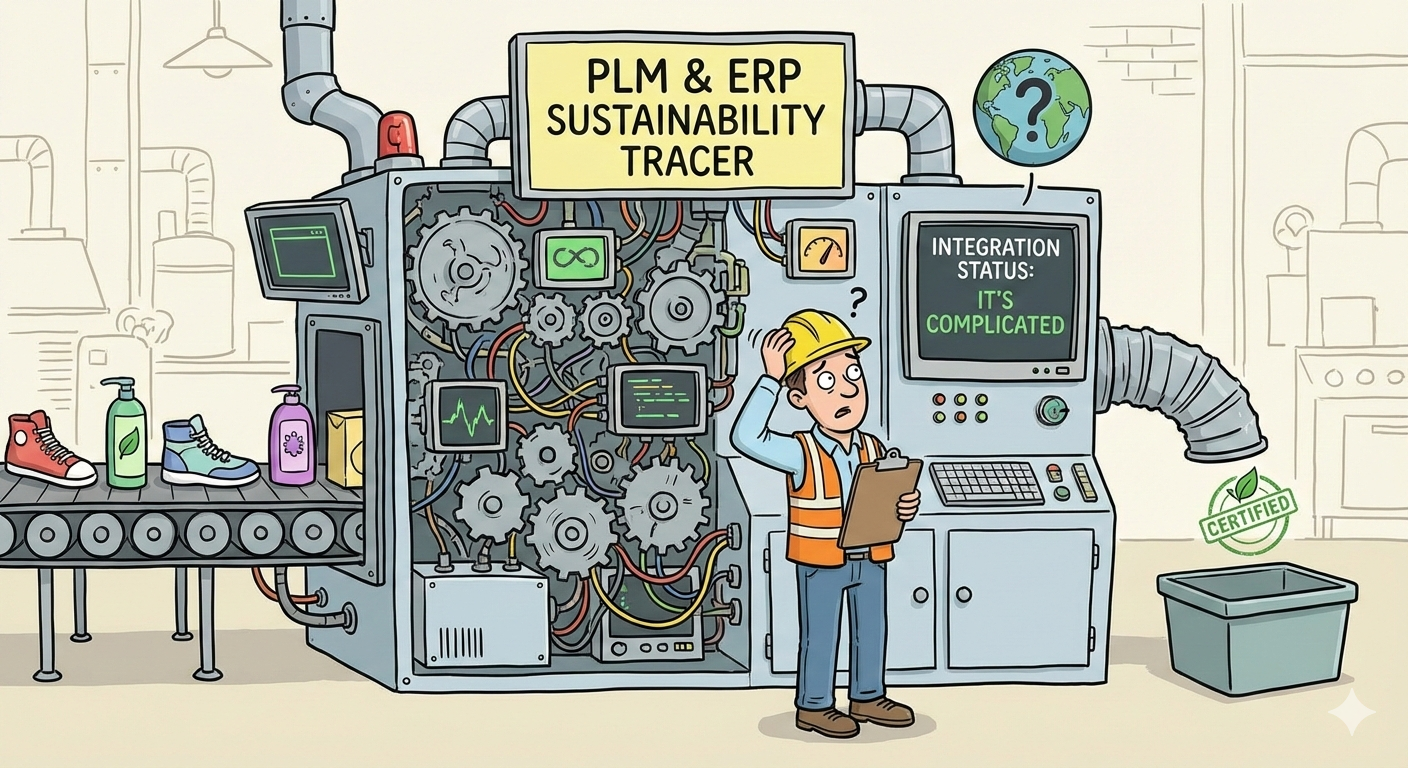
The global consumer goods industry is currently undergoing a transformative shift. For decades, corporate success was measured through the “top line” of revenue growth and the “bottom line” of net profitability. However, a third dimension has emerged as equally critical: Environmental Sustainability.1 As international regulatory bodies transition from voluntary disclosure frameworks to mandatory, audited compliance regimes, the ability to track, manage, and report carbon footprints has become a prerequisite for market participation.2 Within this context, Product Lifecycle Management (PLM) serves as the indispensable architectural foundation, enabling organizations to embed carbon traceability directly into the product’s DNA—from the earliest stages of research and development to final distribution and end-of-life recycling.4
The urgency of this transition is underscored by the 2025 regulatory landscape, where the European Union’s Corporate Sustainability Reporting Directive (CSRD) and the Ecodesign for Sustainable Products Regulation (ESPR) have set new benchmarks for transparency.3 For consumer packaged goods (CPG) companies, where Scope 3 emissions frequently exceed 90% of the total carbon footprint, the challenge is not merely one of reporting, but of deep data integration across fragmented supply chains.7 PLM and ERP can be trained to treat carbon data with the same financial-grade precision as cash.
Different PLM and ERP vendors are coming up with their own suit of technology stack. For instance SAP solves this by, leveraging the integration between SAP PLM, SAP S/4HANA, and the SAP Business Technology Platform (BTP) to create a seamless, auditable record of environmental impact.10 I will take SAP as a base in this article to demonstrate the art of the possible.
The Regulatory Framework and the Shift to Mandatory Compliance
The shift toward mandatory ESG reporting represents a departure from the historical reliance on marketing-led sustainability claims. In 2025, several jurisdictions enacted regulations requiring detailed, audited sustainability disclosures that treat environmental impact as a legal obligation.2
The Corporate Sustainability Reporting Directive (CSRD) and ESRS Standards
The CSRD is perhaps the most significant regulatory development for large-scale organizations operating within the EU. It introduces “double materiality,” a concept requiring companies to report on both how sustainability issues create financial risks for the business and how the business impacts society and the environment.3 Compliance is no longer optional for companies meeting specific turnover and asset thresholds.3
Sustainability reporting under the CSRD must adhere to the European Sustainability Reporting Standards (ESRS), which specify the exact metrics and qualitative disclosures required.3 This includes granular data on greenhouse gas (GHG) emissions across Scopes 1, 2, and 3.7 Furthermore, the EU Taxonomy provides a classification system to define which economic activities can be considered “environmentally sustainable,” providing a common language for investors and regulators.3
Ecodesign for Sustainable Products Regulation (ESPR) and the Digital Product Passport (DPP)
Parallel to corporate-level reporting, the EU’s ESPR framework focuses on the product level, setting minimum standards for durability, repairability, and recyclability.6 A central pillar of this regulation is the Digital Product Passport (DPP), a digital twin that accompanies a product throughout its lifecycle.6 The DPP must contain standardized information regarding the product’s composition, carbon footprint, and technical documentation, accessible via a QR code at the point of purchase.6
The timeline for these regulations is aggressive, with significant milestones expected throughout late 2025 and 2026.
| Regulation / Milestone | Expected Timeline | Impact on CPG Industry |
| First ESPR Working Plan | March 2025 | Identification of priority products: textiles, furniture, tires, and detergents.6 |
| Unsold Goods Destruction Ban | Mid 2025 | Mandatory ban on destroying unsold textiles and electronics to prevent waste.6 |
| DPP Registry Acts | Late 2025 | Specifications for service providers, data carriers, and digital credentials for the passport.6 |
| CSRD Mandatory Reporting (FY 2025) | 2026 | First reports due for large listed companies under the new ESRS standards.3 |
| ESPR Product Measures | 2026-2027 | Adoption of the first specific product-level requirements for eco-design.6 |
The consequences of non-compliance are already being felt; in July 2025, a company was fined €1.1 million under France’s AGEC law for failing to provide adequate environmental impact information to consumers.15 This case signals a broader trend toward aggressive enforcement and the end of voluntary sustainability disclosures.2
The SAP Sustainability Portfolio
To meet these complex requirements, SAP has developed an ERP-centric sustainability architecture built on the foundation of SAP S/4HANA and the SAP Business Technology Platform (BTP).11 This architecture is designed to “Record, Report, and Act,” ensuring that sustainability data is integrated into the core financial and operational systems of the enterprise.17
SAP Sustainability Footprint Management (SFM)
At the heart of the carbon tracking process is SAP Sustainability Footprint Management (SFM), a cloud-based solution that calculates carbon footprints at scale.10 SFM pulls master data and transactional data—such as material movements and energy invoices—directly from SAP S/4HANA Cloud to calculate product carbon footprints (PCF) and corporate carbon footprints (CCF).10
The SFM architecture utilizes AI-powered emission factor mapping to match purchased materials with scientific LCA databases, significantly reducing the manual effort required to manage thousands of SKUs.10 By embedding these results back into business processes, such as procurement or production planning, organizations can make “carbon-aware” decisions in real time.10
SAP Sustainability Control Tower (SCT)
While SFM handles the complex calculations, the SAP Sustainability Control Tower (SCT) serves as the holistic steering and reporting layer.13 SCT consolidates ESG metrics from across the enterprise, including social KPIs (such as diversity and pay equality) and environmental data from SFM.11
SCT is designed to be audit-ready, providing the transparency and data lineage required for CSRD compliance.13 It allows executives to set strategic “ambitions” and operationalize them through granular target setting, using real-time dashboards to compare current performance against goals.17
SAP Sustainability Data Exchange (SDX)
Addressing the specific challenge of Scope 3 emissions, SAP Sustainability Data Exchange (SDX) provides a secure channel for sharing carbon data across the supply chain.7 SDX allows CPG companies to move away from industry averages and instead request actual, primary carbon data from their suppliers.7 This is achieved using the PACT (Partnership for Carbon Transparency) standards, which ensure interoperability between different software systems and prevent the double-counting of emissions.7
The Role of SAP BTP and Integration Components
The seamless flow of data between these systems is enabled by SAP BTP, which provides the “Sustainability Integration Re-use Component”.21 This component acts as a data provisioning layer, extracting sustainability data from both SAP and non-SAP systems and integrating it into end-to-end business processes.21
| System Component | Role in Carbon Tracking | Data Source/Integration |
| SAP S/4HANA | Core Transactional Engine | Material Master, BOMs, Purchase Orders, Facility Energy Flow.1 |
| SAP SFM | Calculation Engine | Footprint inventory, modeling, and AI-driven factor mapping.10 |
| SAP SCT | Reporting & Steering | Consolidation of ESG metrics, ESRS templates, and AI report drafting.11 |
| SAP SDX | Supply Chain Connectivity | PACT-compliant carbon data sharing with multi-tier suppliers.7 |
| SAP BTP | Integration Platform | Connectivity, data modeling, and AI services for all sustainability apps.11 |
SAP PLM Data Elements for Carbon Footprinting
For CPG companies, the product is the primary unit of both environmental and financial value. Therefore, carbon tracking must begin at the design phase within SAP PLM.4 By managing the technical specifications and recipes of a product, PLM provides the granular detail necessary to calculate a highly accurate carbon footprint.
Material Master and Specification Management
The foundational data object in this process is the Material Master (Transaction MM01).23 However, in CPG industries—particularly food, beverage, and cosmetics—the Material Master is often linked to a more detailed “Specification” in SAP PLM.4
Specification management allows for the storage of complex attributes that are not typically found in a standard Material Master. These include:
- Physical and Chemical Data: Detailed composition of raw materials and substances.4
- Allergen and Diet Declarations: Critical for food safety and labeling compliance.4
- Global Warming Potential (GWP): Custom characteristics can be assigned to specifications to store the CO2e value per unit of mass, derived from LCA databases or supplier disclosures.4
- Value Assignments: Standardized fields for compositions, nutrient data, and physical properties that SFM uses as inputs for footprint modeling.4
The Material Bill of Material (BOM)
The Bill of Material (BOM) defines the list of components—including raw materials, intermediate goods, and packaging—required to manufacture a finished product.24 In SAP S/4HANA, the BOM is critical for carbon tracking as it provides the hierarchical structure used to aggregate emissions.1
| BOM Field | SAP Technical Field | Relevance to Carbon Tracking |
| BOM SAP Number | STLNR | Unique identifier for the product structure used in SFM.24 |
| Item Node | STLKN | Tracks individual components and their specific emission profiles.24 |
| Base Unit of Measure | MEINS | Ensures consistent conversion of mass to carbon intensity.23 |
| Quantity | MENGE | Defines the amount of each component, directly scaling the carbon impact.24 |
| Validity Period | DATUV | Essential for tracking footprint changes over time as recipes evolve.24 |
When a CPG company updates a product’s recipe—for example, by substituting a high-carbon ingredient with a plant-based alternative—the change in the Material BOM is immediately reflected in the SFM calculation.4 This allows for “dynamic carbon accounting,” where the footprint of every production batch is calculated based on its actual material consumption.1
Packaging Specifications and SAP Responsible Design and Production (RDP)
Packaging often represents a significant portion of a consumer product’s environmental impact and is subject to increasing regulation through plastic taxes and Extended Producer Responsibility (EPR) fees.2 SAP PLM handles packaging through detailed specifications (Transaction /SCWM/PACKSPEC), which define the materials and hierarchy used in shipping and handling.23
SAP Responsible Design and Production (RDP) extends this capability by tracking “Packaging Elements” and their material fractions.25
| Packaging Attribute | Data Element Category | Strategic Implication |
| Material Fraction | Plastic, Paper, Metal, Glass | Determines the base emission factor and applicable plastic taxes.25 |
| Recycled Content (%) | Post-consumer (PCR) vs. Virgin | Key metric for reducing product-level carbon and meeting circularity goals.25 |
| Recyclability Class | High, Medium, Low Recyclability | Influences EPR fees and consumer-facing sustainability labels.25 |
| Usage Context | Household vs. Industrial | Critical for reporting under UK and EU EPR regulations.25 |
By integrating these packaging specifications with the warehouse and logistics data in S/4HANA, CPG companies can track the total environmental footprint of a product as it moves through the distribution network.26
The Green Ledger: Financial-Grade Carbon Accounting
A central limitation of traditional carbon accounting has been its reliance on annual averages and retrospective reporting. SAP’s “Green Ledger” initiative aims to solve this by integrating carbon data directly into the financial ledger.10 This approach allows companies to treat carbon with the same precision, auditability, and timeliness as financial transactions.10
Transitioning from Averages to Transactions
The Green Ledger shift means that carbon emissions are no longer just estimated at the corporate level; they are recorded as part of every material movement and production order.10
- Transactional Recording: Every time a goods receipt is posted from a supplier, the actual carbon footprint of those materials is recorded alongside the purchase price.10
- Carbon Allocation: In manufacturing, the emissions from energy use (Scope 1 and 2) are allocated to specific product batches based on actual production data from the ERP.1
- Financial Alignment: Carbon footprints can be allocated to profit centers, business segments, or cost centers, allowing for “carbon-adjusted” profitability analysis.10
This level of detail is essential for meeting the requirements of the Green Ledger, which requires that carbon data be “financial-grade” and “audit-ready”.10 It empowers CFOs to assess the financial impact of carbon taxes (such as CBAM) and the potential risks associated with high-emission product lines.2
AI and Automation in Carbon Management
Given the thousands of materials and suppliers in a typical CPG value chain, manual data entry is impossible. SAP leverages AI within SFM and SCT to automate the most labor-intensive tasks.10
- Emission Factor Mapping: AI algorithms analyze material master data and suggest the most appropriate emission factors from LCA databases, increasing mapping accuracy by up to 80%.11
- Declaration Image Analysis: In SAP Green Token, AI is used to autonomously review and extract information from supplier sustainability declarations, regardless of their format, and post the data directly to the traceability system.11
- Report Generation: Within SCT, AI assists in drafting comprehensive ESG reports by automatically collecting relevant metrics, creating visual graphs, and applying the correct regulatory templates.11
Scope 3 Management and Supplier Engagement
For the CPG industry, the “Scope 3 challenge” is the most significant hurdle to achieving net-zero targets. Emissions from purchased goods and services (Category 3.1) often constitute the largest portion of the environmental footprint.7
Moving from Estimates to Primary Data
Historically, companies relied on “spend-based” analysis, where they estimated emissions based on the amount of money spent with a supplier.28 However, this method is too imprecise for regulatory compliance.20 SAP SDX enables a shift to “activity-based” or “supplier-specific” data.7
| Data Source | Accuracy Level | Mechanism in SAP |
| Secondary Data (LCA) | Moderate (Averages) | AI mapping in SFM using ecoinvent or US EPA databases.20 |
| Primary Data (Supplier PCF) | High (Actuals) | Secure exchange via SAP SDX and PACT-compliant formats.7 |
| Sourcing Events | High (Targeted) | Product questionnaires in SAP Ariba to collect PCF during bidding.9 |
| Batch-Level Actuals | Very High (Granular) | Real-time carbon data integration via the Green Ledger.10 |
Advanced Traceability with SAP Green Token
In some CPG segments, such as textiles and food, materials are often commingled, making it impossible to physically separate sustainable and non-sustainable versions of the same material.30 SAP Green Token addresses this through “mass balance” accounting and tokenization.30
The solution captures sustainability attributes (such as “certified organic” or “recycled”) at the point of origin and converts them into digital tokens.11 These tokens follow the material through the production process, ensuring that the volume of sustainable products sold does not exceed the volume of sustainable raw materials purchased.30 This provides an indisputable, auditable record that prevents “greenwashing” and ensures compliance with standards like ISCC and EUDR.11
Implementation Strategy: Building the Sustainable Digital Core
For CPG organizations, the transition to a carbon-aware business model requires a strategic, phased approach to technology implementation.5
Step 1: Data Readiness and Gap Analysis
The first step is a comprehensive assessment of the existing data landscape.3 Organizations must identify where sustainability data is siloed and evaluate the quality of their Material Master and BOM data.4 This phase should also include a “materiality assessment” to determine which ESG metrics are most relevant to the business and its stakeholders.3
Step 2: Establishing the Record-Report-Act Framework
Once the data gaps are identified, the organization should implement the core “Record” functionality by connecting S/4HANA to SFM and SCT.17 This involves:
- Configuring the integration between SAP EHS (Environment, Health, and Safety) for Scope 1 and 2 emissions data.11
- Mapping material master data to emission factors using AI-driven tools.10
- Setting up the SAP Sustainability Control Tower to automate the generation of ESRS-compliant reports.11
Step 3: Engaging the Supply Chain
With the internal systems in place, the focus shifts to Scope 3 management.7 This involves onboarding key suppliers to SAP SDX and integrating carbon questionnaires into the procurement process via SAP Ariba.7 Organizations should prioritize their most carbon-intensive suppliers to achieve the maximum reduction impact.20
Step 4: Operationalizing Sustainability
The final phase is to embed sustainability insights back into core business processes.10 This includes:
- Integrating carbon footprints into product design and recipe development within SAP PLM to enable “design-for-sustainability”.4
- Using carbon data in production planning and logistics to optimize for the lowest-emission supply chain routes.1
- Aligning sustainability targets with financial performance through the Green Ledger.10
Conclusion: The Strategic Value of the Sustainability
The integration of SAP PLM, S/4HANA, and the broader sustainability portfolio provides consumer goods companies with the tools necessary to navigate the most challenging regulatory environment in history.2 By treating carbon as a core business metric—managed with the same rigor as revenue and costs—organizations can move beyond simple compliance and transform sustainability into a source of competitive advantage.1
As the industry moves toward 2027 and the full implementation of the Digital Product Passport, the ability to provide transparent, auditable data on every SKU will be the hallmark of a successful, resilient brand.6 The journey to the Green Ledger is not merely a technical implementation; it is a fundamental shift in corporate strategy, placing the “green line” at the center of the sustainable enterprise.1 In an era where sustainability is no longer optional, the digital core provided by SAP is the essential engine for driving profitable, responsible growth.22
Appendix
- SAP Launches Carbon Emissions Accounting System to Address Climate Change, accessed December 30, 2025, https://news.sap.com/2020/06/launch-sap-carbon-product-carbon-footprint-analytics/
- Reflecting on 2025 Compliance Trends: 7 Key Regulatory Developments and Shifts, accessed December 30, 2025, https://www.sustainable-markets.com/2025-compliance-trends/
- What is CSRD (Corporate Sustainability Reporting Directive)? | SAP, accessed December 30, 2025, https://www.sap.com/sea/resources/csrd-guide
- Managing Your SAP Product Lifecycle Management (PLM) in CPG …, accessed December 30, 2025, https://www.crescenseinc.com/insights/plm-in-cpg
- SAP PLM for Process Industries Transformation – KaarTech, accessed December 30, 2025, https://www.kaartech.com/blogs/sap-plm-for-process-industries-transformation/
- How will the EU ESPR & DPP impact consumer product markets …, accessed December 30, 2025, https://www.sgs.com/en-ch/news/2025/07/cc-2025-q2-how-will-the-eu-espr-and-dpp-impact-consumer-product-markets
- SAP Sustainability Data Exchange, accessed December 30, 2025, https://www.sap.com/products/business-network/sustainability-data-exchange.html
- SAP Sustainability Data Exchange with Westernacher, accessed December 30, 2025, https://westernacher.com/sap-sustainability-data-exchange/
- Collecting primary data for calculating Scope 3 Emissions with SAP Solutions – A proof of concept, accessed December 30, 2025, https://community.sap.com/t5/sustainability-blog-posts/collecting-primary-data-for-calculating-scope-3-emissions-with-sap/ba-p/13543680
- SAP Sustainability Footprint Management | Carbon Footprint Software, accessed December 30, 2025, https://www.sap.com/products/scm/sustainability-footprint-management.html
- SAP Sustainability Architecture – Part 3 – Products and Services, accessed December 30, 2025, https://community.sap.com/t5/enterprise-architecture-blog-posts/sap-sustainability-architecture-part-3-products-and-services/ba-p/14074834
- Navigating Sustainability: How SAP Can Transform Your ESG Reporting – Emixa, accessed December 30, 2025, https://www.emixa.com/blog/navigating-sustainability-sap-esg-reporting
- SAP Sustainability Control Tower, accessed December 30, 2025, https://www.sap.com/products/scm/sustainability-control-tower.html
- Digital Product Passport – Catena-X, accessed December 30, 2025, https://catena-x.net/use-case-cluster/digital-product-passport/
- Digital Product Passports: Unlocking Opportunities Beyond Compliance – Intertek, accessed December 30, 2025, https://www.intertek.com/blog/2025/12-04-digital-product-passports/
- June 2025 ESG Regulatory Updates: 260 Global Changes – Compliance & Risks, accessed December 30, 2025, https://www.complianceandrisks.com/blog/esg-corporate-compliance-update-june-2025/
- SAP Sustainability Control Tower with Westernacher, accessed December 30, 2025, https://westernacher.com/sap-sustainability-control-tower-sct/
- SAP Sustainability Control Tower – ISB Global, accessed December 30, 2025, https://info.isb-global.com/hubfs/SAP%20Campaign%20Assets/SAP%20Sustaintability%20Control%20Tower%20L2%20Pitch%20Deck.pdf
- Understanding SAP Sustainability Footprint Management to Track and Manage the Carbon Footprint – SAP Community, accessed December 30, 2025, https://community.sap.com/t5/supply-chain-management-blogs-by-sap/understanding-sap-sustainability-footprint-management-to-track-and-manage/ba-p/13568870
- Complying to EU Corporate Sustainability Reporting… – SAP …, accessed December 30, 2025, https://community.sap.com/t5/sustainability-blog-posts/complying-to-eu-corporate-sustainability-reporting-directive-scope-3/ba-p/14033847
- Overview on Business Architecture – SAP Learning, accessed December 30, 2025, https://learning.sap.com/learning-journeys/configuring-managing-and-preparing-master-data-for-reporting-in-sap-ehs-management-environment-management/overview-on-business-architecture
- Consumer Products Industry Software – SAP, accessed December 30, 2025, https://www.sap.com/industries/consumer-products.html
- Packaging Specification in SAP EWM – SastraGeek Solutions, accessed December 30, 2025, https://www.sastrageek.com/post/ewm-packaging-specification-in-sap-ewm
- Material BOM – Prospecta Help Centre, accessed December 30, 2025, https://helpcentre.prospecta.com/documentation/mdo-solutions-for-sap/mdo-for-sap-materials-management-mm/material-bom/
- Packaging Elements | SAP Help Portal, accessed December 30, 2025, https://help.sap.com/docs/sap-responsible-design-and-production/user-guide-sap-rdp/packaging-elements-rdp
- Packaging Specification | SAP Help Portal, accessed December 30, 2025, https://help.sap.com/docs/SAP_S4HANA_ON-PREMISE/9832125c23154a179bfa1784cdc9577a/188d6c7db6534f4398cf2b2865fccb49.html
- Packaging Specification Determination – SAP Help Portal, accessed December 30, 2025, https://help.sap.com/docs/SAP_SUPPLY_CHAIN_MANAGEMENT/ce32eae1b3db423fb4625f3d692cae6f/4888915d404d4073e10000000a42189b.html
- How to collect Scope 3.1 “Purchased Goods and Services” data in 5 practical steps (Especially for SMEs) – Hedgehog, accessed December 30, 2025, https://www.hhc.earth/knowledge-base/articles/supplier-engagement-scope-3-data
- Carbon Minds | Carbon Footprint Data for Chemicals and Plastics, accessed December 30, 2025, https://www.sap.com/products/erp/partners/carbon-minds-carbon-footprint-data-for-chemicals-and-plastics.html
- SAP Green Token | Supply Chain Compliance Software, accessed December 30, 2025, https://www.sap.com/products/scm/green-token.html
- SAP Sustainability Solutions | Customer Success Stories, accessed December 30, 2025, https://www.sap.com/products/sustainability/customer-stories.html
- SAP for Consumer Products: Empowering the CPG Industry – McKinsol, accessed December 30, 2025, https://www.mckinsol.com/sap-for-consumer-products