
Artificial Intelligence (AI) is fundamentally reshaping product data cleansing in the U.S. consumer industry. By automating the identification and correction of errors, deduplication, standardization, and integration of product information from diverse sources, AI-driven solutions are enabling companies to achieve unprecedented levels of data accuracy and operational efficiency. These advancements are directly linked to improved customer experiences, more informed decision-making, and measurable business outcomes such as increased sales and reduced operational costs. However, the adoption of AI-powered data cleansing is not without challenges, including integration with legacy systems, data quality issues, explainability in AI models, and the need for human oversight to ensure trust and compliance.
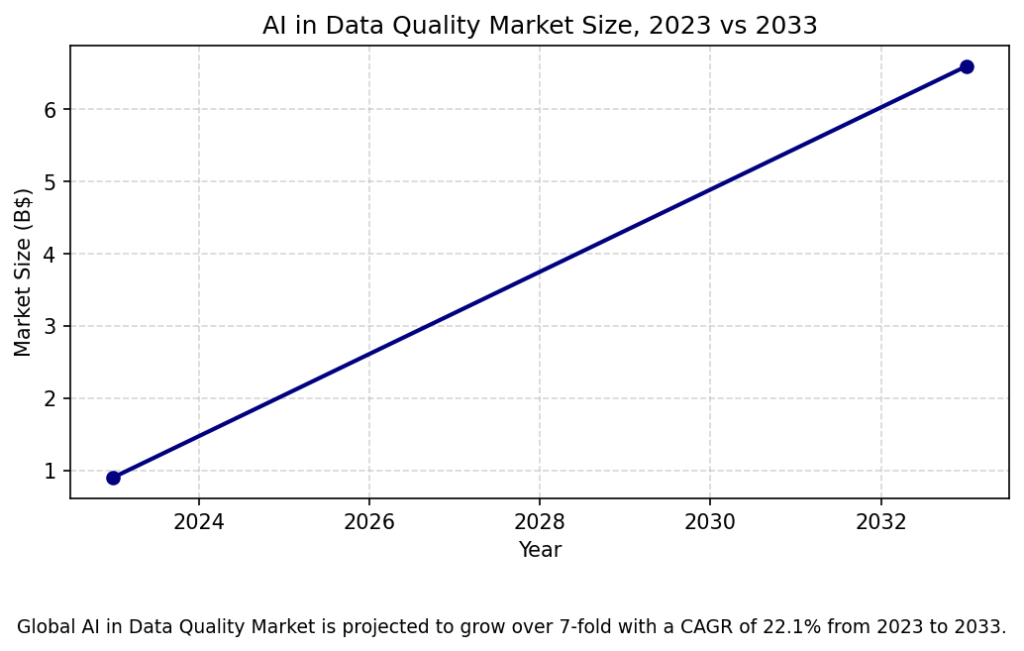
The U.S. consumer industry is experiencing a rapid digital transformation, with AI at the forefront of efforts to manage and optimize vast, complex product data ecosystems. The proliferation of SKUs, expansion of omnichannel retailing, and the rise of AI-powered consumer discovery tools have made high-quality, up-to-date product data a competitive necessity for brands of all sizes. Data cleaning is no longer a purely back-office function; instead, it is directly tied to visibility in digital marketplaces, accuracy in AI-generated recommendations, and the ability to deliver seamless customer experiences. The global AI in Data Quality Market is projected to reach $6.6 billion by 2033, with North America leading adoption due to its concentration of technology innovators and early enterprise investment 1. Expanding adoption is fueled by the exponential growth of data volumes in retail and CPG, with the volume of data worldwide expected to reach 175 zettabytes by 2025. In this environment, AI-driven data cleansing is emerging as a cornerstone for maintaining data integrity, supporting real-time commerce, leveraging predictive analytics, and enabling personalized consumer experiences. The shift from manual or rule-based approaches to scalable, cloud-enabled AI platforms represents a fundamental paradigm change for the U.S. consumer sector 2 3.
Market Segmentation
AI-powered product data cleansing solutions are being adopted across various segments of the U.S. consumer industry, encompassing retail, consumer packaged goods (CPG), e-commerce, and direct-to-consumer brands. Each segment presents unique cleansing demands and presents varying challenges due to data scale, structure, and update velocity. Large CPG companies such as Unilever and Mattel face the logistical complexity of managing millions of SKUs, cross-retailer product placements, and integrating data across global markets 2 4. These organizations are adopting AI to consolidate, harmonize, and automate content updates to meet the dynamic demands of digital shelves, particularly as consumers increasingly interact through AI-generated product discovery and recommendation tools. Meanwhile, agile third-party sellers on platforms like Amazon are utilizing AI to frequently update product detail pages, react to search trends, and optimize retail media spend, often outpacing larger competitors in adopting sophisticated data management tactics 2.
E-commerce and omnichannel retailers are integrating AI-driven data cleansing to facilitate seamless cross-channel experiences, dynamic pricing, and localized personalization. Specialized platforms in areas such as fashion e-commerce employ AI to generate consistent product descriptions and standardize attributes like fit, color, and material, directly influencing conversion rates and reducing returns 5. Additionally, companies in adjacent verticals such as loyalty, direct marketing, and subscription services use AI data cleansing to create unified single-customer views, integrating data from CRMs, POS, and digital touchpoints for more accurate targeting 6.
| Segment | Key Data Cleansing Challenges | Typical AI Solutions Adopted | Unique Needs/Impacts |
| CPG (Large Brand) | Millions of SKUs, cross-retailer | AI-powered digital twins, automated deduplication, real-time cleansing | Integration across global markets, regulatory compliance |
| E-commerce (3rd Party) | High SKU turnover, rapid updates | Automated attribute standardization, error correction, media optimization | Outpacing incumbents via frequent optimization |
| Omnichannel Retail | Multiple data sources, personalization | Real-time data integration, dynamic cleansing workflows | Unified experiences, consistent pricing |
| Direct-to-Consumer | Customer-centric, niche datasets | AI-driven CRM cleansing, NLP for feedback | Personalization, high review conversion |
Competitive Landscape
The competitive advantage in the U.S. consumer sector is increasingly determined by the ability to maintain clean, accurate, and harmonized product data at scale. Smaller, digitally native sellers often outperform established brands on digital platforms due to agile AI-powered data management systems that enable frequent updates and rapid error correction 2. They excel at integrating multiple channels and reacting instantly to shifts in consumer behavior and marketplace trends. Large CPG and omnichannel retailers, despite resource advantages, are sometimes hampered by legacy systems and slower data update cycles, which can propagate stale or inaccurate product information into AI recommendation engines and digital shelves 2 2.
Major technology providers such as IBM, Microsoft, Salesforce, and Google lead the market with cloud-based AI platforms offering scalable data cleansing, deduplication, and integration tools 1 7 6. These platforms benefit from continuous investment, SaaS delivery, and the ability to handle diverse data integrations across enterprise silos. Specialist platforms such as Amperity and Hightouch provide AI-driven identity resolution and customer data unification, serving over 400 clients including top retail and CPG brands 6. AI-fueled SaaS companies emphasize real-time, adaptive, and privacy-compliant solutions, providing tools that process billions of daily transactions and deliver tangible improvements in campaign targeting, product coverage, and operational cost savings.
| Company/Platform | Key AI Capability | Competitive Differentiator |
| IBM | Data Quality Suite, automation, pattern detection | Recognized leader, enterprise scale support |
| Salesforce | Einstein Analytics, AI chatbots | Embedded in CRM, real-time marketing automation |
| Google Cloud | Data Quality Insights, NLP, scalability | Integration with BigQuery, large scale datasets |
| Amperity | AI-powered identity resolution | Real-time unified profiles, cross-industry application |
| Hightouch | Composable CDP, activation & compliance | Fast deployment, integrates with in-house warehouses |
Regulatory Environment
The regulatory landscape for AI-driven data cleansing is shaped by the convergence of data privacy, security, and AI transparency requirements. Key frameworks include the California Consumer Privacy Act (CCPA), the General Data Protection Regulation (GDPR), and regulatory expectations around AI model transparency and explainability as highlighted in the EU AI Act and the NIST AI Risk Management Framework 8 9 10. As more product data is processed in real-time and across borders, companies must ensure that AI-powered processes are audit-ready, respect consumer rights such as right-to-be-forgotten and consent management, and provide clear lineages for how data is cleaned, transformed, and acted upon.
Transparency and explainability are especially critical in consumer industries, as product recommendation engines, personalization workflows, and pricing algorithms come under increasing scrutiny from both consumers and regulators. The ability to demonstrate how AI reached cleansing or integration decisions is becoming a strategic and compliance imperative, with explainability tools and audit trails increasingly being required by industry best practices.
Technological Advancements
AI technologies transforming product data cleansing in the U.S. consumer industry include a range of ML, NLP, computer vision, and robotic process automation (RPA) tools. Machine learning algorithms automate the identification and rectification of errors such as duplicates, inconsistencies, and incomplete records, while NLP can scan unstructured product descriptions and consumer feedback for quality signals and standardization opportunities 11 5. Computer vision is used to analyze and validate product images, materials, and even in developing digital twins that consolidate product variants, labels, and packaging data 4. RPA is used to automate repetitive data migration, validation, and reconciliation tasks.
Cloud-based platforms, exemplified by IBM watsonx, Google Cloud Data Quality Insights, and Salesforce’s Einstein, provide on-demand scalability and integrate seamlessly with other enterprise systems, facilitating real-time cleansing and deduplication across vast and disparate sources 12. AI-powered anomaly detection and pattern recognition continuously improve by learning from corrections and feedback loops with human experts. Systems like Amperity’s Identity Resolution Agent process billions of transactions daily, adapting profiles for over 400 enterprise clients, demonstrating the scale and practical impact of these advancements in the consumer space 6.
AI is also enabling composable and modular approaches to cleansing, such that workflows and data pipelines can be tailored to unique needs, regulatory requirements, or rapidly changing market environments. Automated data profiling, root cause analysis, and self-improving validation rule generation represent the next phase of functionality, with emerging solutions providing explainable AI outputs and full data lineage capabilities to boost trust and auditability.
| Technology | Primary Role in Data Cleansing | Emerging Advancements |
| Machine Learning | Pattern detection, error correction | Automated pipeline optimization, self-learning validation |
| Natural Language Processing | Unstructured data standardization | Context-aware enrichment, review summarization |
| Computer Vision | Image/attribute accuracy, digital twins | Automated component QA, brand compliance |
| RPA | Automated workflows, data migration | Human-in-the-loop escalation, dynamic task allocation |
| Cloud Infrastructure | Scalable, real-time processing | Integration across legacy and modern systems |
Future Forecast
By 2025 and beyond, AI-driven product data cleansing will become a foundational capability and a strategic differentiator for U.S. consumer companies seeking to compete in an increasingly AI-native and omnichannel marketplace. The integration of AI into core data management systems will enable automated and continuous cleansing, deduplication, and enrichment pipelines, providing the backbone for dynamic pricing, hyper-personalized marketing, and seamless channel integration 23 20.
The market for AI in data quality is expected to grow at a CAGR of over 22%, with cloud-based deployments leading adoption—representing 65% of the share in 2023 due to scalability and ease of integration 1. AI-powered cleansing will shift from periodic batch processes to always-on, feedback-driven continuous flows—directly linking product data accuracy to real-time commerce agility. Companies that make early, robust investments in AI infrastructure, data governance, and workforce upskilling will be best positioned to capitalize on new AI-native opportunities—such as answer engines, agentic commerce, and automated campaign optimization—and to minimize emerging risks around compliance and operational integrity.
Strategic Insights
AI-powered product data cleansing is not merely a technical upgrade but a strategic imperative for consumer companies. Clean, accurate, and integrated product data underpins every aspect of the modern consumer journey, from AI-driven search and recommendation engines to dynamic pricing, omnichannel engagement, and supply chain optimization 2 24. As AI-native commerce emerges (agentic shopping, answer engines, multi-modal queries), maintaining data quality at real-time velocity and scale—across all endpoints—will separate leaders from laggards. Companies must therefore prioritize data governance frameworks; aggressively adopt scalable, explainable, and secure AI cleansing platforms; and foster a culture of AI fluency and human-AI collaboration to maximize the technology’s business impact 25 26.
Furthermore, ongoing investments in sustainability for AI infrastructure, regulatory adaptation, and robust explainability tools will be critical for long-term success as consumer trust and compliance scrutiny increase 22 10. Firms with proactive strategies around these imperatives will be best positioned to capture new growth—and avoid costly missteps—as AI redefines the competitive landscape in U.S. consumer markets.
Recommendations
Invest in Scalable, Cloud-Based AI Platforms: Adopt industrial-grade, cloud-driven AI solutions capable of handling dynamic, high-volume product datasets and integrating with both new and legacy systems 1 7.
Prioritize Data Governance and Quality: Define clear data ownership, validation rules, and continuous quality monitoring programs; invest in self-learning cleansing tools and establish comprehensive audit trails for regulatory and business assurance 27 28.
Foster Human-AI Collaboration: Ensure AI automation is supplemented by human domain expertise, review escalations, and transparency, particularly for edge cases and compliance monitoring, to maintain accuracy and organizational trust 18 29.
Focus on Integration and Interoperability: Commit to modernizing legacy technology stacks where needed and leverage modular AI platforms to accelerate integration across disparate ecosystems 17 30.
Prepare for Regulatory and Ethical Requirements: Embed transparency, explainability, and privacy-by-design into AI models and processes; remain vigilant on evolving global and U.S. legal frameworks governing data and AI activities 10.
Appendices
- [1] AI in Data Quality Market Size, Share | CAGR of 22.10% —> Google
- [3] 51114 Database Directory Publishing in the US Industry Report.pdf —> IBIS World
- [5] Top 6 Common Product Data Mistakes in Fashion Ecommerce and How AI Fixes Them —> Google
- [7] 51121C Business Analytics Enterprise Software Publishing in the US Industry Report.pdf —> IBIS World
- [8] 10 Biggest Challenges of AI Data Cleaning and How to Overcome Them – Numerous.ai —> Google
- [9] 51 Information in the US Industry Report.pdf —> IBIS World
- [11] Why AI-Powered Data Cleansing Beats Traditional Methods? —> Google
- [12] Top 10: Data Cleaning Tools for AI – AI Magazine —> Google
- [14] AI vs Traditional Data Cleaning Methods (Which One Is Faster and More Accurate) —> Google
- [15] Why AI–Powered Data Cleansing Beats Traditional Methods? —> Google
- [16] 7 Data Management Trends Driving AI & Personalization in 2025 – BlastX Consulting —> Google
- [18] Implementing AI in Data Cleaning: Challenges and Solutions – ixsight —> Google
- [23] Consumer markets industry trends 2025 – PwC —> Google
- [24] AI in Consumer Goods: Top Use Cases You Need To Know – SmartDev —> Google
- [26] Harmonizing Data, Intuition And AI For Smarter Decisions – Forbes —> Google
- [27] 10 Tips for Improving Product Data Accuracy – Akeneo —> Google
- [28] Predicting Demand Trends with AI – BDO USA —> Google
- [30] Data challenges in leveraging AI in the enterprise – The Agile Brand Guide —> Google
- [2] 5 Charts Showing How Big CPGs Are Losing to Third-Party Sellers on Amazon —> Dow Jones
- [4] 9 Brands That Doubled Down On AI in 2025 —> Dow Jones
- [6] ADWEEK Tech Stack Awards: The AI, UX, Data, and CRM Solutions to Your 21st Century Problems —> Dow Jones
- [10] The Ripple Effect of Clarity in Artificial Intelligence —> Dow Jones
- [13] Smart Cart: Inside Amazon’s AI-Powered Reinvention of Shopping, From Rufus to Conversational Commerce —> Dow Jones
- [17] CEOs’ Biggest AI Fear Is Surprisingly Old School —> Dow Jones
- [19] Shoppers Turn to AI Before Retailers This Shopping Season —> Dow Jones
- [20] The 6 AI Trends That Will Dominate 2026 —> Dow Jones
- [21] Why Midsize Companies Are Best Positioned to Thrive in the Age of AI —> Dow Jones
- [22] Google, Oracle, Amazon, Meta In Hot AI Race. But A Data Center Backlash Is Surging. —> Dow Jones
- [25] AI Is the New Employee and Colleague. Leaders Must Be Ready for the Change —> Dow Jones
- [29] Why Leaders Must Inject the Possibility of Error Into AI —> Dow Jones