
As U.S. manufacturing faces mounting global competition, supply chain volatility, and rising operational costs, firms are increasingly turning to Product Lifecycle Management (PLM) as a strategic lever to boost output, efficiency, and innovation. Advanced PLM systems offer a centralized, data-driven approach to managing products from ideation through retirement, streamlining development, improving cross-functional collaboration, and accelerating time-to-market.
The U.S. manufacturing sector is undergoing a profound transformation, driven by digitalization, automation, and the need for greater agility in the face of global disruptions. Traditional manufacturing models, often characterized by siloed data and fragmented workflows, are ill-suited to the demands of rapid product innovation and complex supply chains. PLM has emerged as a critical enabler of this transformation, providing a unified platform for managing product data, processes, and collaboration across the entire lifecycle. The integration of PLM with technologies such as AI, IoT, and digital twins is further amplifying its impact, enabling manufacturers to respond swiftly to market changes, reduce errors, and optimize resource utilization 1.
Beyond the technological imperative, increasing regulatory demands, pressures for sustainability, and fluctuating geopolitical factors—including trade policy shifts and supply chain localization—have made operational agility and transparency even more crucial. The contemporary drive towards reshoring and reindustrialization, supported by both federal and state incentives, places further emphasis on efficiency and time-to-market. 2 Companies are responding by investing heavily in digital infrastructure and workforce training, positioning PLM as foundational in their competitive playbooks 3. Moreover, advancements in robotics, workforce augmentation, and AI-fueled predictive analytics are increasingly being embedded within PLM systems, strengthening their role as orchestrators of digital transformation and smart manufacturing. 4 5
Recent studies suggest that the most resilient manufacturers are those that simultaneously address digital adoption and organizational readiness. This means integrating PLM not just as an IT investment, but as a cross-functional change management initiative that aligns data, processes, and people behind a unified vision for product development and delivery. 6 7
What does existing Research Say about PLM Adoption?
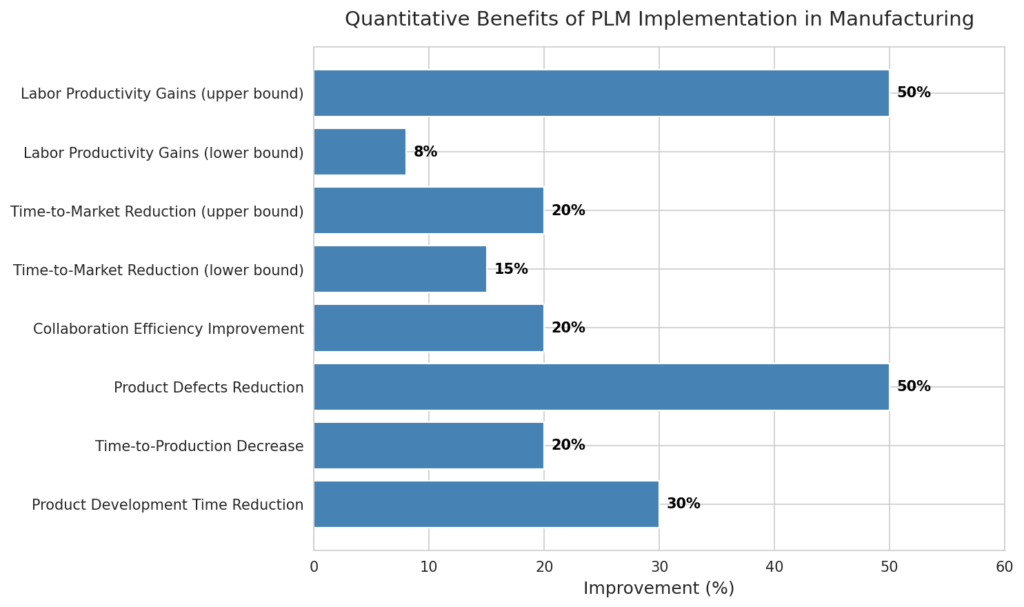
Research consistently demonstrates that PLM adoption leads to significant improvements in manufacturing efficiency and output. Industry reports highlight that PLM systems streamline product development by centralizing data, automating workflows, and facilitating real-time collaboration between design, engineering, production, and supply chain teams 8 9. Integration with ERP and other enterprise systems ensures data consistency and visibility, reducing manual errors and redundant tasks 10 11. Studies show that companies implementing PLM can achieve a 30% reduction in product development time, a 20% decrease in time-to-production, and up to a 50% reduction in product defects 12 13.
Decades of manufacturing research reinforce that PLM-enabled improvements are not merely incremental. McKinsey, Gartner, and other analysts have extensively documented that PLM integrations enable labor productivity gains of up to 40% 14, with digital twin and automation adoption directly linked to sustained output increases and quality control improvements across both large and midsize enterprises. 1 4 15 Firms equipped with advanced PLM and analytics tools generate quantitative benefits, such as a reported 8%–50% increase in productivity for small to medium-sized enterprises adopting smart manufacturing and digital platforms. 16 17
Importantly, the literature confirms the strategic value of cross-functional and supply chain collaboration fostered by PLM systems. Centralizing product data and automating version control alleviates communication gaps, prevents design errors, and generates a 15–20% drop in time-to-market 18 19. In regulated industries such as medical devices and aerospace, PLM provides traceability and compliance monitoring capabilities essential for avoiding costly recalls or production delays. 20 21 22
Emerging technologies are reshaping PLM’s role in manufacturing. AI-driven analytics, IoT-enabled real-time monitoring, and digital twins are enabling predictive maintenance, automated design optimization, and agile supply chain management 23 24 25. These advancements support faster iteration cycles, improved decision-making, and enhanced product quality. Workforce development and change management are also recognized as critical success factors, as the complexity of PLM implementation requires upskilling and cross-functional engagement 1 6.
The literature also underscores key implementation challenges: difficulty integrating with legacy IT systems, significant up-front investments, data migration issues, and resistance to organizational change. 26 27 28 Best practices stress the importance of phased rollouts, robust governance, and continuous training for successful PLM adoption.
| Quantitative PLM Benefits Reported in Literature | Range of Outcomes |
| Reduction in product development time | Up to 30% |
| Decrease in time-to-production | 20% |
| Reduction in product defects | Up to 50% |
| Collaboration efficiency improvement (after PLM integration) | 20% |
| Reduction in time to market | 15%–20% |
| Labor productivity gains (from smart/digital adoption including PLM) | 8%–50% |
| Cost savings from digital re-industrialization | Over 20% for 54% firms |
Key Arguments & Perspectives
Streamlining Product Development and Reducing Time-to-Market
PLM systems provide a single source of truth for all product-related data, eliminating silos and ensuring that teams work from the latest approved designs and documentation 29 30. This centralization accelerates change management, reduces the risk of errors, and shortens development cycles. Automated workflows and real-time data sharing enable faster approvals and more agile responses to design changes or supply chain disruptions 31 19. As a result, manufacturers can bring products to market more quickly, gaining a competitive edge and capturing early revenue opportunities.
The impact of PLM-enabled time-to-market acceleration is amplified by integration with digital twins and advanced analytics. Digital twins allow virtual simulation of products and processes, facilitating rapid prototyping, early identification of design flaws, and predictive modeling for manufacturing outcomes 17 25. This reduces the frequency and costs associated with physical prototypes while allowing teams to optimize resource allocation and adapt scheduling in real time. AI-driven PLM solutions further enhance this by automating bottleneck identification, forecasting demand, and recommending design alternatives or supplier substitutions should issues arise 32 33.
Companies also report that modular and cloud-based PLM architectures allow for quick adjustments to production capacity in response to demand fluctuations, making it easier to introduce product variants or update features without lengthy system reconfigurations 15. Integrated change order management ensures that engineering, manufacturing, and sourcing teams remain aligned, minimizing costly mid-stream corrections and improving overall output velocity.
| Development Time Reduction | 30% |
| Time to Production Decrease | 20% |
| Time to Market Reduction | 15-20% |
Enhancing Collaboration Across Departments and the Supply Chain
Effective PLM integration breaks down barriers between design, engineering, manufacturing, and procurement, fostering seamless collaboration 34 18. Cloud-based PLM platforms and integrated communication tools allow geographically dispersed teams and external partners to access and update information in real time, reducing miscommunication and delays 35 36. This collaborative environment supports concurrent engineering, rapid prototyping, and efficient supply chain coordination, all of which are essential for scaling output and managing complexity in modern manufacturing.
Advanced PLM solutions enable secure, role-based access to product data for diverse stakeholders, ensuring manufacturers and suppliers can collaborate without jeopardizing intellectual property or regulatory compliance. Supplier enablement features within PLM platforms automate notifications about design changes, parts standards, and quality requirements, creating a feedback loop that minimizes supply chain confusion and constrains risk propagation across tiers 35 37. Integration with ERP and MES systems further closes the loop by synchronizing scheduling, planning, and production execution, ensuring relevant parties work off the most current data 10 21.
AI-augmented PLM platforms take collaboration even further by employing real-time analytics to detect misalignments between departments or supply chain nodes—for example, signaling procurement if design engineering has issued an unanticipated part substitution or providing manufacturing engineers with automated alerts about supplier delays. 32 When cross-departmental integration is achieved, PLM systems have been shown to yield a 20% improvement in collaboration efficiency and measurably reduce process waste, according to a CIMdata report. 18
Improving Efficiency, Minimizing Errors, and Reducing Rework
By automating routine tasks, standardizing processes, and embedding quality controls into workflows, PLM systems significantly reduce the incidence of errors and costly rework 38 39. Digital validation, feedback loops, and version control ensure that only the most accurate and up-to-date information is used throughout the product lifecycle 29 40. AI-enhanced PLM tools further support error reduction by providing predictive analytics, automated compliance checks, and real-time monitoring of production processes 41 25.
Empirical studies of PLM implementation reveal that error-related rework, which can consume as much as 2% of annual revenues in some sectors, is cut by up to 50% when digital validation and automated workflows are fully deployed 13 39. Embedding real-time quality checkpoints, digital work instructions, and automated version control reduces the risk of users relying on outdated specifications, a common cause for error propagation and unnecessary rework. 42 43 Moreover, integrating PLM with smart sensor networks and IoT devices enables real-time monitoring of production equipment, ensuring that potential quality issues are flagged before they impact downstream activities or trigger costly recalls. 44 25
Furthermore, lessons from failed digital transformation projects—such as the U.S. Department of Veterans Affairs EHR rollout—highlight the pitfalls of insufficient user-centric design, lack of local process validation, and inadequate error management. These findings underscore the importance of robust testing, process mapping, and frontline engagement in minimizing the risk of new errors or systemic inefficiencies when rolling out major PLM platforms. 45
| Defect/Quality-Related Cost Reduction | 30% |
| Product Defect Reduction | 50% |
| Annual Scrap/Rework Cost Savings | 0.6-2.2% Rev |
Accelerating Innovation and Enabling Customization
PLM platforms enable manufacturers to rapidly iterate on designs, incorporate customer feedback, and manage complex product variants 46 8. The integration of generative AI and digital twins allows for virtual prototyping and simulation, reducing reliance on physical prototypes and enabling faster innovation cycles 17 32. This agility supports the development of high-value, customized products that meet evolving market demands.
Digital platforms now enable real-time capture and integration of customer preferences into product design cycles, which is especially relevant in industries with high customization requirements, such as apparel, electronics, and aerospace. 46 47 AI-powered design tools not only automate the generation of feasible design alternatives but also optimize for manufacturability and cost constraints, decreasing design iteration time by up to 40%. 12 48 Additionally, PLM systems facilitate the implementation of circular economy business models by providing end-to-end traceability and enabling rapid repurposing or refurbishing of products, which is increasingly favored in sustainability-driven market segments. 49
The continuous data feedback offered by connected PLM-ERP systems means that product development is no longer a linear process; instead, feedback from consumers, aftersales, and the supply chain can prompt mid-lifecycle enhancements, proactive quality improvements, and enhanced customer satisfaction scores. 34 50
Recommendations
To maximize the benefits of PLM and enhance manufacturing output, U.S. firms should consider the following best practices:
Align PLM with Business Strategy: Clearly define objectives for PLM implementation, ensuring alignment with broader business goals such as innovation, cost reduction, and market responsiveness 7 53. Treatment of PLM as an outcome-focused initiative rather than a technology deployment is essential for securing executive sponsorship and sustained value delivery.
Engage Cross-Functional Teams Early: Involve representatives from all relevant departments in the planning and implementation process to ensure buy-in, address concerns, and foster collaboration 54 55. Cross-functional engagement is especially critical in mitigating resistance and clarifying cross-departmental data ownership and process flows.
Invest in Workforce Development: Provide comprehensive training and upskilling programs to equip employees with the skills needed to operate advanced PLM systems and adapt to new workflows 1 56. Evidence from both automation and AI adoption indicates that effective upskilling directly enhances productivity and ensures a smooth transition, minimizing disruptions and risk of skill gaps.
Integrate PLM with Enterprise Systems: Ensure seamless integration with ERP, CRM, CAD, and supply chain management platforms to enable real-time data flow and unified decision-making 10 11. The use of APIs, middleware, or standardized data models is a best practice to facilitate interoperability and minimize manual rework between systems.
Leverage Emerging Technologies: Adopt AI, IoT, and digital twins to enhance predictive analytics, automate routine tasks, and enable real-time monitoring and optimization of production processes 23 25. Integration of these emerging technologies not only accelerates product development but also provides new differentiators in customization and responsive manufacturing.
Prioritize Change Management: Address resistance to change through transparent communication, leadership commitment, and the empowerment of internal champions to drive adoption 6 28. Change management programs should include peer influence strategies, feedback mechanisms, and gradual adoption staging.
Focus on Data Quality and Governance: Establish robust data management practices to ensure accuracy, consistency, and traceability across the product lifecycle 57 40. This includes planning for data migration from legacy systems, instituting rigorous version control, and building ongoing validation processes for master data.
In addition, manufacturers should pursue pilot deployments before scaling, use outcome-based key performance indicators to measure PLM success, and collaborate closely with technology partners who function as true business allies, not just software vendors 58. Case illustrations, such as the VA EHR deployment failure, make clear that implementation effectiveness hinges on the interplay of technology with organizational process and cultural adaptation 45.
| Best Practice | Tangible Benefit |
| Executive alignment/goals setting | Faster adoption, better ROI |
| Early cross-functional involvement | Reduced resistance, improved data quality |
| Workforce upskilling and training | Smoother transition, higher productivity |
| Seamless system integration | Minimized manual rework, unified data view |
| AI/IoT/Digital twin adoption | Shorter time to market, better forecasting |
| Robust change management | Higher adoption rates, lower risk of project failure |
| Data governance and quality controls | Consistent, trusted decision making |
Conclusion & Call to Action
Strategic investment in advanced PLM systems is a proven pathway for U.S. manufacturers to enhance output, streamline operations, and accelerate innovation. By centralizing product data, automating workflows, and fostering cross-functional collaboration, PLM enables firms to reduce time-to-market, minimize errors, and respond agilely to market and supply chain disruptions. However, realizing these benefits requires a holistic approach that integrates technology, people, and processes. U.S. manufacturers are encouraged to adopt best practices in PLM implementation, invest in workforce development, and leverage emerging technologies to secure a competitive advantage in the evolving manufacturing landscape.
Given the quantitative and qualitative evidence, U.S. firms must act decisively—moving beyond incremental pilot programs and adopting PLM as an integral, organization-wide driver of operational excellence, innovation, and growth in a radically transformed global marketplace.
Appendices
- [1] 31-33 Manufacturing in the US Industry Report.pdf —> IBIS World
- [2] The resurgence of manufacturing – Reindustrialization strategies in Europe and the US – 2025 – Capgemini —> Google
- [4] Emerging Technologies in Manufacturing Market Research Report 2025 —> Google
- [8] Best PLM Software for Manufacturing: Top Solutions for 2024 – Modelcam Technologies —> Google
- [9] Top Benefits of PLM Services for Manufacturing & Engineering – Modelcam Technologies —> Google
- [10] 4 Ways To Boost Supply Chain Efficiency With PLM-ERP Integration – Xavor Corporation —> Google
- [11] PLM Integration – Pimberly —> Google
- [12] Product Lifecycle Management Software Market Size, Share – Market.us —> Google
- [13] The Benefits Of End-to-End Product Lifecycle Management For Manufacturers —> Google
- [14] What are the emerging technologies reshaping labor productivity management systems, and what case studies can illustrate their impact? Consider incorporating references from Gartner and McKinsey on technology trends. —> Google
- [16] Accelerating Digital Technology Adoption Among U.S. Small and Medium-Sized Manufacturers —> Google
- [17] Three trends in manufacturing innovation for 2024 | AWS for Industries —> Google
- [18] How PLM Software Transforms Collaboration Between Design and Production Teams – Insight Blog – AgilityPortal —> Google
- [19] Time to Market: How to Accelerate Product Development with PLM – Duro Labs —> Google
- [20] Enhancing Product Lifecycle Management (PLM) Efficiency: Key Strategies for Medical Device Manufacturers – Argano —> Google
- [21] Choosing PLM to Improve Production Speed and Capacity in A&D – Tech-Clarity —> Google
- [22] Valentino Partners with Centric Software to Streamline Product Development, Improve Collaboration and Power Strategic Initiatives – PR Newswire —> Google
- [23] (PDF) The 2025 Outlook for U.S. Manufacturing Strategic Integration of Advanced Artificial Intelligence and Reasoning LLMs – ResearchGate —> Google
- [24] AI For Product Lifecycle Management – Meegle —> Google
- [25] AI in Product Lifecycle Management – Visure Solutions —> Google
- [26] 13 Common PLM Implementation Problems And How to Avoid Them —> Google
- [27] 5 Things Stopping Engineering Teams and Manufacturing Companies from Adopting PLM —> Google
- [28] Ultimate Guide to PLM Implementation: Best Practices and Common Challenges —> Google
- [29] Product Lifecycle Management Explained: Systems, Benefits, and Use Cases —> Google
- [30] PLM – Product Lifecycle Management | JANUS Engineering USA —> Google
- [31] PLM’s Impact on Time to Market and Innovation Efficiency – Arena Solutions —> Google
- [32] AI in PLM: Top Use Cases You Need To Know – SmartDev —> Google
- [33] Unlocking Value from Product Lifecycle Management in Manufacturing – Nick Leeder —> Google
- [34] Aligning PLM With Your Business Strategy for Maximum Success – Arena Solutions —> Google
- [35] Extend PLM capabilities for resilient, adaptable supply chains and collaborative networks —> Google
- [38] Reduce errors – Click-PLM —> Google
- [39] How to Reduce Scrap and Rework Cost in Manufacturing – Pico MES —> Google
- [40] Rethinking PLM ROI in the Digital Age: From Single Database to Connected Services —> Google
- [41] AI in PLM: Transforming Product Lifecycle Management for the Digital Age – RFID JOURNAL —> Google
- [42] PLM Software Limitations: Challenges and Solutions – ComplianceQuest —> Google
- [43] The Impact of PLM Engineering on Sustainable Manufacturing Practices – Eontes —> Google
- [44] 32212 Paper Mills in the US Industry Report.pdf —> IBIS World
- [46] 31-33 Manufacturing in the US Industry Report.pdf (additional sections) —> IBIS World
- [47] How PLM Can Shorten The Time to Market for Fashion Brands – ApparelMagic —> Google
- [48] Product Lifecycle Management With AI Market Research Report 2033 – Dataintelo —> Google
- [51] A Look at Three PLM Success Stories: A Story from the Field – Ultra Consultants —> Google
- [53] PLM Implementation Best Practices – ComplianceQuest —> Google
- [54] 8 Best Practices for a Smooth PLM Implementation | CNTD – Cre8tive Technology & Design —> Google
- [55] PLM Implementation Best Practices – Sovelia —> Google
- [57] 11 Essential Product Lifecycle Management Best Practices for Success – Cre8tive Technology & Design —> Google
- [3] 7 Trends Shaping Economic Growth Across the U.S.� —> Dow Jones (Potential Hallucination)
- [5] The Trump Administration Is Shifting Its Focus From AI to This Burgeoning Industry —> Dow Jones
- [6] Change Management Is Broken. These 4 Numbers Explain Why —> Dow Jones
- [7] Leaders Must Stop Doing AI and Start Using It —> Dow Jones (Potential Hallucination)
- [15] Why Midsize Companies Are Best Positioned to Thrive in the Age of AI —> Dow Jones
- [36] ADWEEK Tech Stack Awards: The AI, UX, Data, and CRM Solutions to Your 21st Century Problems —> Dow Jones
- [37] How Companies Can Capitalize on Geopolitical Turmoil —> Dow Jones
- [45] Staff flag dangerous errors in VA records —> Dow Jones
- [49] How Eileen Fisher and Tony’s Chocolonely Are Rethinking Business —> Dow Jones
- [50] Mattel Brings AI Into the Toy Room With OpenAI Deal —> Dow Jones
- [52] Palantir Wins U.S. Navy Contract For Nuclear Submarine Fleet. Potential Bigger Than Maven? —> Dow Jones
- [56] Sacramento-area chipmakers need workers. Sierra College tries to meet demand —> Dow Jones
- [58] Why the Right Ally Defines Supply Chain Resilience —> Dow Jones